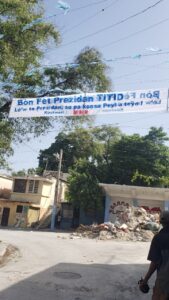
What’s Behind The Crisis in Haiti? April, 2026
On February 29, 2004, the democratically elected government of President Jean-Bertrand Aristide of Haiti was overthrown by a violent coup. This was the second U.S.-sponsored coup against a popularly elected Aristide government, the first one taking place in 1991 after he had served only eight months in office.
Orchestrated by the United States, France, and Canada, and then sanctioned and enforced by a United Nations military occupation, the 2004 coup forced President Aristide, his wife and colleague, Mildred Trouillot Aristide, and their two children into exile, and removed more than 8,000 elected officials. Thousands more were killed, raped, or forced to flee their homes. The country has still not recovered.
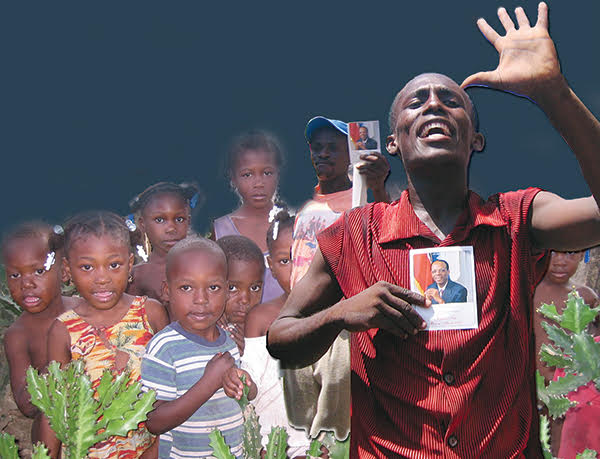
The coup shattered the work of the most progressive government in Haiti’s history. In the period of governance by Fanmi Lavalas, the party founded by President Aristide, more schools were built than the total constructed between 1804 and 1994. Twenty percent of the country’s budget was mandated for education. Women’s groups and popular organizations helped coordinate a literacy campaign that brought over 320,000 people, mostly women, into literacy classes in over 20,000 literacy centers. The minimum wage was doubled. A powerful initiative was undertaken to combat the spread of HIV/AIDS. Health clinics were established in the poorest communities. The government also launched an aggressive campaign to collect unpaid taxes owed by the wealthy elite. Aristide disbanded the notorious Haitian military and empowered women’s and victims’ groups to bring cases against the military for its use of rape as a political weapon.
In the months after the 2004 coup, Haitians courageously demonstrated their support for Aristide and his Fanmi Lavalas political party, raising five fingers in a call for him to complete his five-year term. Their resistance has never stopped.
The Centuries-Old Assault on Haiti
The 2004 coup was the continuation of a centuries-old attack on Haitian sovereignty. In 1791, 400,000 Africans enslaved in Haiti rose against French colonial rule, launching a revolutionary war that culminated in Haiti’s independence in 1804, establishing the world’s first Black republic. From that moment on, Haiti has been in the crosshairs of white supremacist imperial powers. The United States led a worldwide boycott against Haiti. It refused to recognize the new republic until 1864, knowing that Haiti was an inspiration to enslaved people everywhere and posed a grave danger to the U.S.’s own system of slavery. In 1825, French warships encircled Port-au-Prince and forced Haiti to assume a debt to France of 90 million gold francs (equivalent to $21.7 billion as calculated in 2003) as reparations to the former slaveowners for the “crime” of freeing themselves from slavery. With the first payment of the debt, Haiti had to close its nascent public school system. In 1915, the US invaded Haiti and occupied the country for 19 years, taking over Haiti’s banking system, defeating a peasant-led insurgency, and installing one puppet regime after another. This culminated in the Duvalier dictatorships, which terrorized the country for close to 30 years.
The Crisis in Haiti Today
The current crisis in Haiti stands as a sharp rebuke to those who plotted and carried out the coup in 2004, and to the foreign occupation that has bedeviled Haiti ever since. There are currently no elected officials in Haiti, the result of years of rule by decree by illegitimate governments. Under the watchful eyes of the U.S. and its so-called Core Group of foreign occupiers, Haiti has descended into what grassroots organizers have called a “hell on earth.”
For years, people across the length and breadth of Haiti have been demanding an end to the terror unleashed by Viv Ansamn, a coalition of paramilitary death squads aligned with and empowered by sectors of the business elite and government. Faced with a government that has shown only an occasional willingness to fight the death squads, community self-defense groups have formed to resist paramilitary attacks on their neighborhoods. In the last year alone, over 8000 Haitians have been killed, primarily by the death squads, and more than 1.4 million Haitians have had to flee their homes. Nearly half the population is facing acute hunger, as roads are blocked, homes, farms, and businesses have been burned down, and markets have been attacked. Tens of thousands of children have been unable to attend school. Gang rapes and kidnappings have become the norm as paramilitaries escalate their attacks on opposition neighborhoods. The despised Haitian Army, disbanded by President Aristide in 1995, has been reconstituted, readying itself to commit yet more human rights violations.
A transitional presidential council (TPC), demanded for years by Fanmi Lavalas and other grassroots organizations as a stepping stone towards free and fair elections, was sabotaged by the U.S. State Department, which made sure it was dominated by the same right-wing parties that have produced what Haitians call a “slow motion genocide”. In 2025, the TPC signed a 10-year multi-million dollar contract with Erik Prince’s mercenary group, Vectus Global, formerly known as Blackwater, which is infamous for massacres of civilians during the Iraq war. Just like in Iraq, these mercenary forces – armed with high-powered weapons, including drones – have already committed massive human rights violations. In addition, Haiti’s government has signed an $85.4 million contract with foreign private for-profit prison firms to build three new prisons, an ominous sign of even more repression to follow.
So now, Haitians stand between a rock and a hard place: on the one hand, emboldened and well-connected paramilitary death squads determined to have their share of power, and on the other hand, a government dominated by the business elite that is using its police powers and mercenaries to wreak havoc on the poor.
As of February 7th, 2026, the TPC has been dissolved, leaving only the U.S.-backed Prime Minister, Alix Fils-Aime, in power. When widespread opposition to Fils-Aime surfaced within Haiti, Secretary of State Marco Rubio warned Haitians that there would be “grave consequences” if Fils-Aime were removed from office. With a U.S. warship off the coast of Haiti and a U.N.- organized multinational force of 5,500 troops gearing up to deepen the occupation of Haiti, we can expect another fraudulent election, aimed at installing yet another neo-colonial regime, beholden once again to the United States.
Haitian Refugees Under Attack
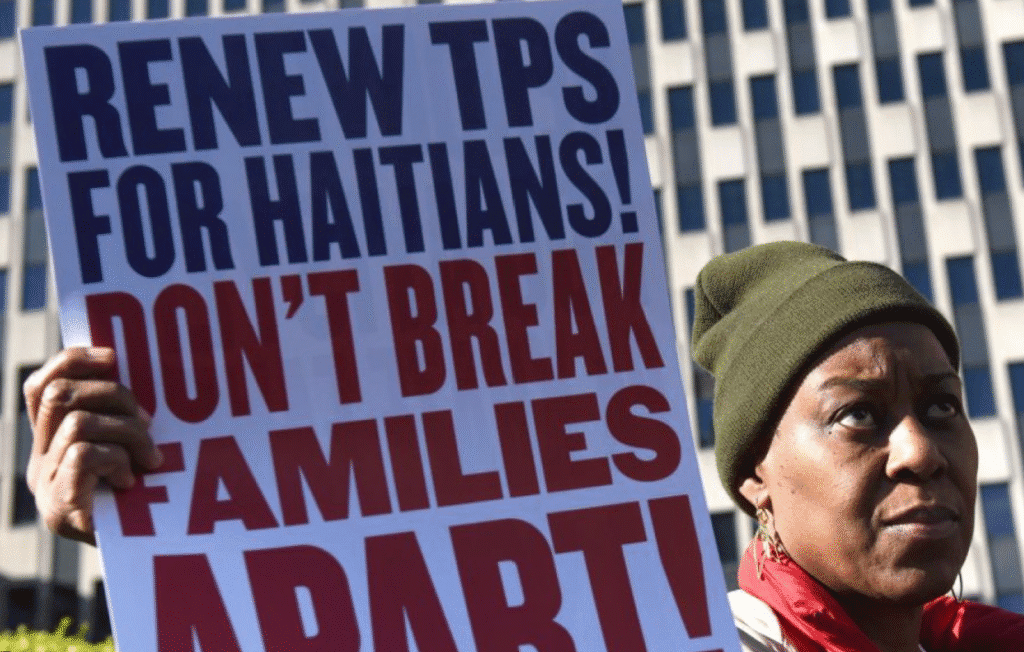 As the Trump Administration continues its onslaught against refugees, Haitians living within U.S. borders are again being targeted. Throughout their 2024 election campaign, Trump and Vance demonized Haitians, going so far as to falsely accuse Haitians in Springfield, Ohio, of eating their neighbors’ pets. This outrageous, racist lie fueled anti-Haitian attacks throughout Ohio. Shortly after Trump’s inauguration, the Department of Homeland Security attempted to end Temporary Protective Status (TPS) for over 350,000 Haitians now in the United States. This, despite the State Department issuing travel warnings, telling Americans not to travel to Haiti because of the dangerous conditions there. Trump has also attempted to end the Humanitarian Parole Program for Nicaraguans, Haitians, Venezuelans, and Cubans, threatening hundreds of thousands more refugees with deportation.
On March 6, 2026, the U.S. Court of Appeals for the D.C. Circuit upheld a ruling that the termination of TPS for Haiti was unlawful and based on “racial animus.” This ruling allows beneficiaries to maintain their status and keep their work permits for the moment. But the Trump Administration has already filed an emergency appeal to the Supreme Court, which has ruled against refugees over and over again. In response, Congressional supporters of Haitian migrants have put forward an initiative aimed at extending TPS for Haitians for another three years.
This is a period when activism in support of Haitian migrants could have a real impact and Haiti Action Committee will be working together with many other solidarity and immigrant rights groups to keep up the pressure.
Building Solidarity
Haiti Action Committee has stood with the popular movement in Haiti since our founding in 1992. We have maintained our solidarity through the 2004 coup, the deadly earthquake of 2010, the joyous return of President Aristide in 2011, the stolen elections of 2015 and 2016, the devastation unleashed by Hurricane Matthew in 2016, and the earthquake that struck Haiti’s southern peninsula in August 2021. We will continue to support Haitian refugees who have fled the terror unleashed by one U.S.-backed reactionary regime after another. And we are standing with the Haitian grassroots movement as it provides support to a population under daily attack, defends communities, and continues to develop and sustain programs to build a new, just, and democratic Haiti.
This is a time to buttress our solidarity. We hope you will join us in our work.
Support the vital work of Haiti’s grassroots movement! Donate to the Haiti Emergency Relief Fund at www.haitiemergencyrelief.org